sábado, 4 de maio de 2019

'65 Fors Galaxie 500 (Hot Wheels 50 Years Series - Gulf)


The Ford Galaxie is a full-sized car that was built in the United States of America by Ford for model years 1959 through to 1974. The name was used for the top models in Ford's full-size range from 1958 until 1961, in a marketing attempt to appeal to the excitement surrounding the Space Race. For 1962, all full-size Fords wore the Galaxie badge, with "500" and "500/XL" denoting the higher series. The Galaxie 500/LTD was introduced for 1965 followed by the Galaxie 500 7-Litre for 1966. The Galaxie 500 prefix was dropped from the LTD in 1966, and from the XL in 1967;[2] however the basic series structuring levels were maintained. The "regular" Galaxie 500 continued below the LTD as Ford's mid-level full-size model from 1965 until its demise at the end of the 1974 model year.[3]:401–42

The Galaxie was the competitor to the high-volume full sized Chevrolet Impala.[4]

The similarly named Ford Galaxy is a large car/minivan available in the European market. The vehicle's name is believed to be derived from the original Ford Galaxie.

The 1965 Galaxie was an all-new design, featuring vertically stacked dual headlights. The cars were taller and bulkier than the previous year's. The new top-of-the-line designation was the Galaxie 500 LTD.[citation needed] Engine choices were the same as 1964, except for an all-new 240 cu in (3.9 L) six-cylinder engine replacing the 1950s-era 223 "Mileage-Maker" six and the 352 was now equipped with dual exhausts and a four-barrel carburetor.

Suspension on the 1965 models was redesigned. Replacing the former leaf-spring rear suspension was a new three-link system, with coil springs. Interiors featured a new instrument panel and two-way key system were introduced. The introduction of two keys was for valet parking, in that the rounded head key would only open the trunk or locked glove compartment, while the squared head key would only unlock the doors and the ignition.

A new model was introduced for 1966; the Galaxie 500 7 Litre, fitted with a new engine, the 345 hp 428 cu in (7.0 L) Thunderbird V8. This engine was also available on the Ford Thunderbird and the Mercury S-55. The police versions received a 360 hp version of the 428 known as the 'Police Interceptor' as police cars. The 1966 body style was introduced in Brazil (Ford do Brasil) as a 1967 model; it had the same external dimensions throughout its lifetime until Brazilian production ended in 1983.

domingo, 21 de outubro de 2018

'69 Customize Volkswagen Squareback


The Volkswagen Type 3 is a compact car that was manufactured and marketed by Volkswagen from 1961 to 1973. Introduced at the 1961 Frankfurt Motor Show, Internationale Automobil-Ausstellung (IAA), the Type 3 was marketed as the Volkswagen 1500and later as the Volkswagen 1600, in three body styles: two-door NotchbackFastback and Squareback, the latter marketed as the 'Variant' in most markets, and 'Squareback' in the United States.
The Type 3 diversified Volkswagen's product range beyond the existing models – the Type 1 Beetle, Type 14 Karmann GhiaType 2 (Bus) – while retaining several of the Beetle's key engineering principles, notably the air-cooled rear-engine, rear-wheel drive layout and all-round torsion bar suspension on the same 2,400 mm (94.5 in) wheelbase.
The Type 3 followed the Type 1 Beetle, utilizing a low-profile version of Volkswagen's rear-engined, 4-cylinder air-cooled engine, as well as body-on-chassis construction while featuring ponton styling in contrast to the Type 1's articulated fender and running board. VW finalized the design by 1959 with prototypes ready for testing by 1960. Secrecy was such that even at the 1960 Geneva Auto Show, VW denied they were readying a new design. In 1961 VW announced the new line as the "VW 1500".
Production began in August 1961, a month before launch, of the Volkswagen 1500 Notchback, encompassing three-box styling in a notchback saloon body.[3] Production of the Karmann Ghia 1500 (also known as the Type 34 Karmann Ghia) with a coupé body commenced in November 1961 and deliveries started in January 1962.[3] The estate bodied Variant (marketed as the Squarebackin the USA) followed, with the first cars produced in February 1962.[3] Two convertibles based on the 1500 Notchback were also announced with the original models, but did not enter production.[4]
The Fastback, or TL version, a fastback coupé, arrived in August 1965, at the same time the 1600 engine was introduced. Volkswagen's intention was that this model should replace the Notchback, which is what happened in the UK market, but in other markets, including the German domestic market, the number of customers preferring the older Notchback shaped car was higher than foreseen, and in the end both Notchback and Fastback body shapes remained in production until July 1973.[5] The Type 3 also featured wall-to-wall carpeting, and was available with air conditioning in the US.
Volkswagen of America began importing the Type 3 in 1966 in the "Squareback" ('Variant' badges were not used in the US market) and "Fastback" but not the Notchback configurations. The Type 3 was competing in the market with the Chevrolet Corvair that had been previously introduced in the United States in 1960, which incorporated a 6-cylinder rear-mounted air-cooled engine in notchback and station wagon body style, as well as a compact van derived from the platform.
In 1968, the Type 3 'E' (Einspritzung) became the first German automobile in series production with electronic fuel injection (Bosch D-Jetronic) as standard equipment. The larger Volkswagen Type 4 was introduced in 1969 which had a similar mechanical layout with further engineering refinements.
For the 1968 model year, 1969 in the USA, a three-speed fully automatic transaxle became available, noted for extremely low internal friction. With the automatic came completely independent rear suspension (IRS), replacing the swing axle ( IRS) set-up. For 1969, the IRS rear axle was standard with both automatic and manual transmissions.
The model received a facelift in 1970, when a 115 mm (4.5 in) nose-lengthening added 1.5 cu ft (42 L) to the luggage capacity.[6] At the same time it got new big square-section bumpers and much larger tail lamps and front indicators.
Volkswagen offered the Type 3 in a lower trim level in Europe, marketed as the 1600A trim level. In the US, and for 1973 only, Volkswagen offered two trim levels of the Type 3 Fastback in the USA, marketed as the Type 3 Sedan and Type 3 Basic Compact. The Basic Compact featured reduced content, including limited color and upholstery availability and without belt line chrome, clock, electric rear window defogger – and with painted frames around the vent windows, a black cardboard front trunk liner over the gas tank without a liner on the sides of the trunk or over the firewall, plain vinyl door panels without door pockets and rubber mats in lieu of interior carpet.[citation needed]
While the Type 3 was a more modern design, it never reached the same level of popularity as the Beetle. As Volkswagen started to produce front-wheel-drive water-cooled designs, production ended in 1973 at the Wolfsburg plant, with production moving to VW's new Emden plant, which was later retooled in 1973 to build the first generation Passat (marketed variously, also as the "Dasher"). The Wolfsburg plant was retooled to build the Golf, which eventually replaced the Type 1 as Volkswagen's best selling sedan.
The Type 3 was initially equipped with a 1.5 L (1493 cc) engine based on the air-cooled 1192 cc flat-4 found in the Type 1, but given a 69 mm stroke it became the basis for the 1300 cc and 1600 cc engines that followed in the later Beetle (Type 1) and Volkswagen Type 2 T1 and T2.[citation needed] While the long block remained the same as the Type 1, the engine cooling was redesigned by putting the fan on the end of the crankshaft instead of on the generator. This reduced the height of the engine profile, allowed greater cargo volume, and earned the nicknames of "Pancake" or "Suitcase" engine. The engine's displacement would eventually increase to 1.6 L (1584 cc).
It used a similar transmission to the Beetle but with higher ratios (4.125 R&P v 4.375 R&P) and longer axles. Unlike the Beetle (Type 1), the Type 3 engine and transmission unit was mounted into a subframe (which contained the complete rear suspension), in turn rubber-mounted to the floorpan and body, thereby isolating vibration and road noise from the passenger space.
The original Volkswagen 1500 used a single side-draught 32 mm Solex PHN carburetor. In August 1963 VW introduced single- and twin-carburetor versions, respectively the Volkswagen 1500 'N' (Normal), rated at 45 PS (33 kW; 44 hp), and the 1500 'S' (Super), 54 PS (40 kW; 53 hp) which had high-compression (8.5:1) domed 83 mm pistons and twin downdraught 32 mm Solex PDSIT carburetors for more power.
The Type 3 engine received a larger displacement (1.6 L) for 1966 (August '65) and in 1968 became the world's first volume production car to feature electronic fuel injection – pioneered by Bosch. The Bosch D-Jetronic system was offered on the Volkswagen 1600 TE & LE version (E designating "Einspritzung" or "injection" in German). A similar Bosch injection system was used in the later Type 4 VW 411, some models of the Porsche 914, Opel Admiral, Diplomat and Commodore, and available for the Volvo 1800E/ES, 142E, and certain 1972-75 140 and 164 series cars (see Volvo P1800). Also introduced for 1968 was a fully automatic transmission.
A notable advance from the Type 1 to the Type 3 was the front suspension — although similar to the Type 1, it was the first Volkswagen front suspension to incorporate transverse round torsion bars, as opposed to the Type 1's torsion leaves. The Type 3's torsion bars are cross-mounted in the lower tube, so that each individual torsion bar spans the full width of the car, the upper tube containing an anti-roll bar that connects the upper trailing links to each other. The complete front suspension unit is rubber-mounted to the car's floorpan. In 1968 the rear suspension was upgraded to double jointed CV joint semi trailing arm suspension (sometimes called IRS by VW enthusiasts to differentiate it from the previous ( IRS ) swing-axle type), a design feature that previously appeared on the VW Type 2 in 1967.
The Type 3 offered both front and rear enclosed luggage areas, with greater volume and cargo accessibility via both the boot (trunk) and the bonnet (hood). In each of the 3 variants (Notchback, Squareback, and Fastback) as well as the Type 2's from 1968 on, the engine was located under a panel in the rear trunk.
This unusual placement was highlighted in a period Volkswagen television commercial for the American market. It featured actor Dustin Hoffman showing the interior of the Fastback model and explaining the car's technical features but unable to locate the engine. The ad closed with the copy, "Your VW dealer will show you where the motor is."
The original Type 3 with 5-stud wheels (5 x 205 mm PCD) used twin leading shoe drum brakes at the front. In August '65 (the '66 model year) these were replaced by disc brakes, coinciding with the introduction of the Fastback and 1600 engine (Australian built models retained drum front brakes until August 1967). These have 4-stud wheels (4 x 130 mm PCD) with 8 cooling slots. Rear brakes were always leading / trailing shoe drums.

segunda-feira, 17 de abril de 2017

73 Ford Falcon (XB) Last of the V8 Interceptors - Mad Max (Greenlight)


The Ford Falcon (XB) is a full-size car that was produced by Ford Australia from 1973 to 1976. It was the second iteration of the third generation of this Australian-made model and also included the Ford Fairmont (XB), the luxury-oriented version of the Falcon.

The Ford Falcon was a full-sized car manufactured by the Ford Motor Company of Australia from 1960 to 2016. From the XA series of 1972 onward, each Falcon and range of derivates have been designed, developed, and built in Australia, following the phasing out of the American-influenced Falcon of 1960 to 1971, which had been re-engineered locally as the XK to XY series for the harsher Australian conditions. The luxury-oriented Ford Fairmont model joined the range from 1965. Luxury long-wheelbase derivative versions called the Ford Fairlane and LTD arrived in 1967 and 1973, respectively (with production ending in 2007).

The Ford Falcon and its derivates have been Australian-made best-sellers, with over 3,000,000 sales in seven generations to 2003, almost exclusively in Australia and New Zealand, but also South Africa. Along with its closest Australian-made rival, the Holden Commodore, the Falcon has dominated the ranks of taxis in Australia and New Zealand, as well as police car and company fleets.

In its last incarnation as the FG X series, the body style of the Falcon range consisted of sedan and utility body styles. Luxury variants of the current model Falcon, collectively known as the G Series, were marketed as the Ford G6, G6E, and G6E Turbo, which replaced the long-standing Fairmont and Fairmont Ghia models. Previously the Falcon range also included a hardtop coupé, panel van and station wagon (respectively up to 1978, 1999 and 2010), as well as the Futura variant. The Falcon platform had also spawned luxury models such as the Landau coupe and long-wheelbase Fairlane and LTD sedans.

In May 2013, Ford Australia announced the end of local production, which comprises Falcon and its closely related Territory crossover SUV, by October 2016. This decision is attributable to Ford Motor Company's "One Ford" product development plan introduced in 2008 to rationalise its global range. Under this plan, Falcon's indirect replacements are the fourth-generation Mondeo from Europe and the sixth-generation Mustang from North America – the latter to retain Ford's Australian V8 heritage. The final Ford Falcon, a blue XR6, rolled off the production line on 7 October 2016.

In 1973, the XB Falcon (sold with the slogan "The Great Australian Road Car") was introduced with more aggressive styling, a multifunction control stalk (indicators, high beam, horn), new colours including colour-coded bumpers on the GT variants, and minor trim variations. Engine options carried over from the XA-series. New panel van and utility option packages, "Surferoo" and "Surfsider" vans, and "Overnighter" ute, were introduced.

Power-assisted front disc brakes were now standard across the Falcon range. The GT variant of the XB also included four-wheel disc brakes (the earlier GT/GT-HO models used large finned drums at the rear). The first 211 XB GTs built were fitted with a US-built version of the Cleveland 5.8 litres (351 cu in) V8 known as the 'big port' engine, and later XB GTs were fitted with an Australian-built version of the engine with 'small port' heads. A notable difference in performance is seen between these engines, and also in resale value, as the early US-powered GTs are rarer, so more collectable. The twin driving lights remained, as did the bonnet locks. The bonnet scoops of the GT were now integrated into the "power bulge" on the bonnet, the bumpers were now body-coloured, and the power bulge, wheel arches, sills, and valances were painted in a contrasting colour to the body colour (usually black, but dependent upon the actual body colour choice).

This classic car is world-renowned for its starring roles in the movies Mad Max and Mad Max 2 (The Road Warrior), both starring Mel Gibson. In Mad Max, the police use yellow XA and XB sedans, and Max later drives a customised black XB hardtop known as the Pursuit Special, or black-on-black due to its matte black over gloss black paint scheme. In Mad Max 2 (The Road Warrior) it was referred to as the "Last of the V8 Interceptors". It is often referred to as Max's Interceptor, but all the MFP cars badged "Interceptor" were four-door sedans, including the one Max drove during the Night Rider chase.

The Ford Landau, a two-door "personal coupé" based on the XB Falcon Hardtop was released in August 1973.

In the 1979 film Mad Max, the title character's black "Pursuit Special" was a 351 cu in (5.8 L) version of a 1973 Ford XB GT Falcon Hardtop. Two 1974 XB sedans were also used as Main Force Patrol Interceptor vehicles. More Falcons were used to depict the Pursuit Special in sequels Mad Max 2 (1981) and Mad Max: Fury Road (2015).

segunda-feira, 12 de dezembro de 2016

'70 Plymouth Road Runner Fast Furious (Jada 1:24)


The Plymouth Road Runner is a mid-size car with a focus on performance built by Plymouth in the United States between 1968 and 1980. By 1968, some of the original muscle cars were moving away from their roots as relatively cheap, fast cars as they gained features and increased in price. Plymouth developed the Road Runner to market a lower priced, basic trim model to its upscale GTX.

Plymouth paid $50,000 to Warner Bros.-Seven Arts to use the Road Runner name and likeness from their Wile E. Coyote and The Road Runner cartoons (as well as a "beep, beep" horn, which Plymouth paid $10,000 to develop).[1] The Road Runner was based on the Chrysler B platform (the same as the Belvedere and Satellite), as a back-to-basics mid-size performance car.

The 1970 model year brought new front and rear end looks to the basic 1968 body, and it would prove to be another success. Updates included a new grille, a cloth & vinyl bench seat, hood, front fenders, quarter panels, single-piston Kelsey-Hayes disc brakes (improved from the rather small-rotor Bendix 4 piston calipers of '68 - '69 ), and even non-functional scoops in the rear quarters.[6] The design and functionality of the Air Grabber option was changed. A switch below the dash actuated a vacuum servo to slowly raise the forward-facing scoop, exposing shark-like teeth on either side. "High Impact" colors, with names like In-Violet, Moulin Rouge, and Vitamin C, were options available for that year. The engine lineup was left unchanged although a heavy-duty three-speed manual became the standard transmission, relegating the four-speed to the option list along with the TorqueFlite automatic. This was to be the second and last year of the Road Runner convertible, with only 834 made. The new high-back bucket seats shared with other Chrysler products which featured built-in headrests.

The 440 Six Barrel remained an option for 1970. The 1969 "M" Code Edelbrock aluminum intake was replaced by a factory-produced cast iron piece; however there were some early cars built prior to January 1, 1970 that were equipped with the left over aluminum Edelbrock intake from the year prior.

Sales of the 1970 Road Runner dropped by more than 50 percent over the previous year to around 41,000 units (about 1,000 ahead of Pontiac's GTO but still about 13,000 units behind Chevy's Chevelle SS-396/454). This would also be the last year of the Road Runner convertible with 834 total production. Only 3 Hemi (R) code Road Runner convertibles were built (plus 1 to CANADA). The declining sales of Road Runner and other muscle cars were the result of a move by insurance companies to add surcharges for muscle car policies - making insurance premiums for high-performance vehicles a very expensive proposition. Also, Plymouth introduced another bargain-basement muscle car for 1970, the compact Duster 340 which was powered by a 275 hp (205 kW) 340 4BBL V8 which in the lighter-weight compact A-body could perform as well if not better than a 383 Road Runner. Furthermore, the Duster 340 was priced even lower than the Road Runner and its smaller engine qualified it for much lower insurance rates.

sexta-feira, 2 de dezembro de 2016

'17 Acura NSX(ホットホイール2016シリーズ)


アキュラ(アキュラ・アキュラ?)は、日本の自動車メーカー、ホンダの高級車です。このブランドは、1986年3月に米国とカナダで発売され、高級車、高性能車、高性能車を販売しています。 1991年に香港、2004年にメキシコ、2006年に中国、2014年にロシア、2015年にクウェートに導入された。ホンダは2008年に国内市場にアキュラを導入する予定であったが、 2008年の金融危機の結果として保留された。

アキュラは、日本初の自動車用高級ブランドとしての差別を受けています。アキュラの創設は、高級車を販売していたホンダクリオと呼ばれるJDMホンダディーラー販売チャネルの導入、以前に設立されたホンダVernoに続いて、ホンダプリモに続く翌年に導入されました。最初の数年間、Acuraは米国で最も売れていた高級ブランドのひとつだった。 1990年代半ばから後半にかけて販売は減少しましたが、劇的な再設計と新型モデルの導入により、2000年代初めに復活しました。

創業以来、アキュラは自動車産業の先駆者でした。 1980年代後半、同社初のフラッグシップ車であるレジェンドの成功は、日本の自動車メーカートヨタと日産がそれぞれ独自の高級ブランド、レクサスとインフィニティを投入するよう促しました。 1990年に発売された中型エキゾチックなスポーツカーであるNSXは、ヨーロッパのスポーツカーに代わる信頼性の高い実用的な代替車を提供し、北米市場にはホンダのVTEC可変バルブタイミングシステムを導入しました。 1993年伝説のクーペはホンダが6速マニュアルトランスミッションを最初に使用し、タイプIIエンジンと組み合わされています。 1990年代後半には、軽量化、剛性と低サスペンション、高出力のVTECエンジンを特長とする、コンパクトなIntegraクーペのType Rバージョンを生産しました。

2000年代初めに、同社の最初のすべてのオリジナルSUVであるMDXとIntegraクーペとセダンを置き換えた2つのモデルであるRSXとTSXを含む新しいモデルがAcuraによって導入されました。この10年間で、RSX、CL、TLのタイプSバージョンがブランドのラインナップに追加されました。アキュラの2005年のRLフラッグシップは、トルクベクトル化全輪駆動システムであるSH-AWDを発表しました。クロスオーバーSUVの2007 RDXは北米初のターボチャージャー型のホンダエンジンを搭載しています。 2010年代、アキュラは、ILX、TLX、RLXなどの新モデルをデビューしました。後者はAcuraのJewel Eye LEDヘッドライトを発表しました。第2世代のNSXは2015年に発売され、ツインターボエンジンのミッドエンジン、9スピードのデュアルクラッチトランスミッション、スポーツハイブリッドSH-AWDを搭載しています。.

quarta-feira, 30 de novembro de 2016

'17 For GT (Hot Wheels 2016 series)


The Ford GT is an American mid-engine two-seater sports car that was produced by Ford for the 2005 and 2006 model years. The designers drew inspiration from Ford's GT40 racing cars of the 1960s.
A completely redesigned Ford GT is planned to enter production in 2016 as a 2017 model.
At the 2015 North American International Auto Show and at the unveiling of Forza Motorsport 6, a new Ford GT was introduced and is set to be produced and released in 2016. It will mark 50 years since the GT40 won the 1966 24 Hours of Le Mans and has run successfully in the 2016 24 Hours of Le Mans to mark the anniversary, winning their class.
Ford GT at the 2015 Geneva Motor Show
The car is to be powered by a newly designed 3.5 liter twin-turbocharged EcoBoost V6 engine making over 600 hp (450 kW). According to Ford, "the GT will exhibit one of the best power-to-weight ratios of any production car," thanks to its lightweight carbon fiber construction. Underpinning the GT is a carbon fiber monocoque bolted to aluminum front and rear subframes covered in carbon fiber body panels. The car also has racing inspired pushrod suspension, active aerodynamics, and dihedral doors. The windshield of the vehicle is made of Gorilla Glass manufactured by Corning, which is also used for smartphone screens. Gorilla Glass is used to reduce the weight of the vehicle by allowing for a thinner windscreen with the same strength.

Beginning in December 2016, Ford plans to build the GT at a rate of one car per day until October 2020. 2017 and 2018 model year vehicles will be reserved for selected GT buyers, 2019 vehicles for buyers passed over in the initial selection process, and 2020 vehicles for new customers.

sexta-feira, 12 de agosto de 2016

Wrecker tow truck (Maisto)


Iveco Ferrari (New Ray 1/87)


The Iveco Stralis is a heavy-duty truck produced by the Italian manufacturer Iveco since 2002. The Stralis replaced theEuroStar and EuroTech models; it covers the range above the Eurocargo, between 19 and 44 tonnes. The fire version of the Stralis released with the German based Iveco Magirus.
In 2007, the Stralis received minor changes to cabin and front of the vehicle.[1] All models have the EuroTronic gearbox, which have full or semiautomatic modes. The original Stralis, introduced in 2002, was the first heavy truck with an automated gearbox as standard equipment.[2]
All engines are four-valve straight-6 with modern pump nozzle injection.
Different performance levels from three different capacity variants are available:
  • Cursor 8, 7.8 l capacity: 228-265 KW (310-360 PS)
  • Cursor 10, 10.3 l capacity: 309-331 KW (420-450 PS)
  • Cursor 13, 12.9 l capacity: 368-412 KW (500-560 PS)
All engines are equipped with a high performance decompression exhaust brake known as Iveco Turbobrake.

Long Gone (Hot Wheels Boulevard Series)


CONVOY CUSTOM (Hot Wheels 2013 Pop Culture Series - Magilla)


sexta-feira, 8 de julho de 2016

Drag Dairy (Hot Wheels Collector Edition)


'73 BMW 3.0 CSL Race Car Black Model (Hot Wheels 2016)


The BMW New Six CS (internal name BMW E9) was a two-door coupé built for BMW by Karmann from 1968 to 1975. It was developed from the New Class-based BMW 2000 CS coupé, which was enlarged to hold the BMW M30 straight-6 engine used in the E3 sedan.

The E9 platform, especially the 3.0 CSL homologation special, was very successful in racing, especially in European Touring Car Championship and the Deutsche Rennsport Meisterschaft. This helped to establish BMW's status as a sporty driver's car.

Introduced in May 1972, the 3.0 CSL was a homologation special built to make the car eligible for racing in the European Touring Car Championship. 1,265 were built.

The "L" in the designation meant leicht (light), unlike in other BMW designations, where it meant lang (long). The lightness was achieved by using thinner steel to build the unit body, deleting the trim and soundproofing, using aluminium alloy doors, bonnet, and boot lid, and using Perspex side windows. The five hundred 3.0 CSLs exported to the United Kingdom were not quite as light as the others, as the importer had insisted on retaining the soundproofing, electric windows, and stock E9 bumpers on these cars. The CSL was never sold in the United States.

Initially using the same engine as the 3.0 CS, the 3.0 CSL was given a very small increase in displacement to 3,003 cc (183.3 cu in) by increasing the engine bore by one quarter of a millimetre. This was done in August 1972 to allow the CSL to be raced in the "over three litre" racing category, allowing for some increase in displacement in the racing cars. In 1973, the engine in the 3.0 CSL was given another, more substantial increase in displacement to 3,153 cc (192.4 cu in) by increasing the stroke to 84 mm (3.3 in). This final version of the 3.0 CSL was homologated in July 1973 along with an aerodynamic package including a large air dam, short fins running along the front fenders, a spoiler above and behind the trailing edge of the roof, and a tall rear wing. The rear wings were not installed at the factory, but were left in the boot for installation after purchase. This was done because the wings were illegal for use on German roads. The full aero package earned the racing CSLs the nickname "Batmobile".

Chris Amon, Winner of 6 Hours Race 1973 at Nürburgring with BMW 3.0 CSL

In 1973, Toine Hezemans won the European Touring Car Championship in a 3.0 CSL and co-drove a 3.0 CSL with Dieter Quester to a class victory at Le Mans. Hezemans and Quester had driven to second place at the 1973 German Touring Car Grand Prix at Nürburgring, being beaten only by Chris Amon and Hans-Joachim Stuck in another 3.0 CSL. 3.0 CSLs would win the European Touring Car Championship again in every year from 1975 to 1979.

The 3.0 CSL was raced in the IMSA GT Championship in 1975, with Sam Posey, Brian Redman, and Ronnie Peterson winning races during the season.

The first two BMW Art Cars were 3.0 CSLs; the first was painted by Alexander Calder and the second by Frank Stella.

The 3.5 CSL was built for Group 5 racing and BMW won three races in the 1976 World Championship for Makes with this model.

domingo, 26 de junho de 2016

'73 BMW 3.0 CSL Race Car (Hot Wheels 2016)


The BMW New Six CS (internal name BMW E9) was a two-door coupé built for BMW by Karmann from 1968 to 1975. It was developed from the New Class-based BMW 2000 CS coupé, which was enlarged to hold the BMW M30 straight-6 engine used in the E3 sedan.

The E9 platform, especially the 3.0 CSL homologation special, was very successful in racing, especially in European Touring Car Championship and the Deutsche Rennsport Meisterschaft. This helped to establish BMW's status as a sporty driver's car.
Introduced in May 1972, the 3.0 CSL was a homologation special built to make the car eligible for racing in the European Touring Car Championship. 1,265 were built.

The "L" in the designation meant leicht (light), unlike in other BMW designations, where it meant lang (long). The lightness was achieved by using thinner steel to build the unit body, deleting the trim and soundproofing, using aluminium alloy doors, bonnet, and boot lid, and using Perspex side windows. The five hundred 3.0 CSLs exported to the United Kingdom were not quite as light as the others, as the importer had insisted on retaining the soundproofing, electric windows, and stock E9 bumpers on these cars. The CSL was never sold in the United States.

Initially using the same engine as the 3.0 CS, the 3.0 CSL was given a very small increase in displacement to 3,003 cc (183.3 cu in) by increasing the engine bore by one quarter of a millimetre. This was done in August 1972 to allow the CSL to be raced in the "over three litre" racing category, allowing for some increase in displacement in the racing cars. In 1973, the engine in the 3.0 CSL was given another, more substantial increase in displacement to 3,153 cc (192.4 cu in) by increasing the stroke to 84 mm (3.3 in). This final version of the 3.0 CSL was homologated in July 1973 along with an aerodynamic package including a large air dam, short fins running along the front fenders, a spoiler above and behind the trailing edge of the roof, and a tall rear wing. The rear wings were not installed at the factory, but were left in the boot for installation after purchase. This was done because the wings were illegal for use on German roads. The full aero package earned the racing CSLs the nickname "Batmobile".


Chris Amon, Winner of 6 Hours Race 1973 at Nürburgring with BMW 3.0 CSL
In 1973, Toine Hezemans won the European Touring Car Championship in a 3.0 CSL and co-drove a 3.0 CSL with Dieter Quester to a class victory at Le Mans. Hezemans and Quester had driven to second place at the 1973 German Touring Car Grand Prix at Nürburgring, being beaten only by Chris Amon and Hans-Joachim Stuck in another 3.0 CSL. 3.0 CSLs would win the European Touring Car Championship again in every year from 1975 to 1979.

The 3.0 CSL was raced in the IMSA GT Championship in 1975, with Sam Posey, Brian Redman, and Ronnie Peterson winning races during the season.

The first two BMW Art Cars were 3.0 CSLs; the first was painted by Alexander Calder and the second by Frank Stella.

The 3.5 CSL was built for Group 5 racing and BMW won three races in the 1976 World Championship for Makes with this model.

quinta-feira, 2 de junho de 2016

'55 Chevy 3100 Panel Truck - Hot Wheels Garage


A panel truck in U.S. and Canadian usage is a small delivery truck with a fully enclosed body. It typically has no rear windows in the rear cargo area and is a van built on a truck chassis.

A body design that appeared very early in history of light-duty trucking was the "delivery car or van was actually the first type of panel truck." A panel truck is similar in function to its smaller cousin the sedan delivery, a station wagon with no backseat and no side windows aft of the front doors. Both types of vehicles are frequently used as delivery vehicles.

Panel trucks are often used by construction and maintenance contractors and were sometimes configured for ambulance and hearse roles. Other variations include canopy express models, which have open display areas behind the driver's seat primarily used by farmers for selling fruits and vegetables. The evolution of sport utility vehicles can be traced to panel trucks, as the Chevrolet Suburban and GMC Yukon, as well as the International Harvester Travelall were passenger versions of these trucks. In modern times minivans have been adapted to some of these functions.

The 2001 to 2010 model year Chrysler PT Cruiser is a compact hatchback wagon whose "design that is reminiscent of panel trucks of the past." The 2007 to 2011 Chevrolet HHR panel model was inspired by the Chevrolet Suburban panel truck, although the HHR is also a compact crossover utility vehicle instead of a full-size truck like the Suburban.

Panel trucks were traditionally purchased by commercial users with specific needs, for which a full-size truck was too large, a station wagon too small and a pickup truck too exposed. Most panel trucks lived hard lives, driven until the cost of repair could no longer be justified before being hauled off to the local scrapyard. This 1955 Chevrolet 3100 panel truck for sale on Hemmings.com is the exception to the rule. Used to haul turkeys between buildings on a turkey farm, this mostly original truck sports the 235.5-cu.in. inline six-cylinder engine mated to a three-speed column-shift manual transmission. It isn’t clear if the truck’s 34,463 miles are legitimate, or if the odometer has been rolled, but it appears to be remarkably well preserved for a vintage truck with a 20-year old “minor restoration.” It even comes complete with turkey cages, turkey decoys and other in-period memorabilia, meaning that the next owner can kick off a collection that includes more than just a vintage truck.

terça-feira, 29 de março de 2016

'67 Chevrolet Bel Air (Maisto)


The Chevrolet Bel Air was a full-size automobile that was produced by Chevrolet for the 1950–1981 model years. Initially only the two door hardtops in the Chevrolet model range were designated with the Bel Air name from 1950 to 1952, as distinct from the Styleline and Fleetline models for the remainder of the range. With the 1953 model year the Bel Air name was changed from a designation for a unique body shape to a premium level of trim applied across a number of body styles. The Bel Air continued with various other trim level designations until US production ceased in 1975, production continued in Canada for its home market only through the 1981 model year.

For 1965, the full size Chevrolet was totally restyled, and the cars were stretched to 213.3 in (5,420 mm) overall, even though the wheelbase remained the same. The new stamped grille had a lower extension below the bumper which was slightly veed. Curved window glass and round taillights mounted high characterized the new styling. The interiors were also redesigned and a very attractive dash resulted. The standard V8 remained the 283 CID model of 195 hp (145 kW), but options included two new 396 cu in (6,490 cc) CID engines of 325 and 340 hp (250 kW) and two 409 CID blocks of 400 and 425 hp (317 kW).

The Bel Air utilizes a stainless-steel belt and rocker molding, identifying signature on the rear fenders, a glove compartment light and power tailgate on 9-passenger wagons to distinguish itself from the lower-priced Biscayne series.

For 1967, Full-sized Chevrolets featured a new body with bulging rear fenders, one of this year's styling trends, not necessarily appreciated by everyone. Bel Air 2 and 4-door Sedans continued in addition to 6 and 9-passenger wagons. This year Bel Air featured triple taillights unlike Biscayne's dual units. Standard engines remained the same as the previous year. Optional engines were a 327 CID V8 of 275 hp (205 kW), the 396 CID V8 of 350 hp (260 kW); or the 427 CID V8 of 385 hp (287 kW), plus various speed packages.

The 1965-70 GM B platform is the fourth best selling automobile platform in history after the Volkswagen Beetle, Ford Model T and the Lada Riva.

domingo, 27 de março de 2016

'57 Chevy Bel Air (Hot Wheels garage series)


The Chevrolet Bel Air was a full-size automobile that was produced by Chevrolet for the 1950–1981 model years. Initially only the two door hardtops in the Chevrolet model range were designated with the Bel Air name from 1950 to 1952, as distinct from the Styleline and Fleetline models for the remainder of the range. With the 1953 model year the Bel Air name was changed from a designation for a unique body shape to a premium level of trim applied across a number of body styles. The Bel Air continued with various other trim level designations until US production ceased in 1975, production continued in Canada for its home market only through the 1981 model year.

In 1957 engine displacement grew to 283 cu in (4,640 cc) with the "Super Turbo Fire V8" option producing 283 hp (211 kW) with the help of continuous (closed loop) mechanical fuel injection. These so-called "fuelie" cars are quite rare, since most Bel Airs were fitted with carburetion. The 1957 Bel Air is among the most recognizable American cars of all time; well-maintained examples, especially Sport Coupes and Convertibles are highly sought after by collectors and enthusiasts. They are roomy, with tastefully restrained, period use tail fins and chrome. A second automatic transmission, Turboglide, was optional. While the original two-speed Powerglide continued unchanged, Turboglide provided a continuously variable gear ratio which made "shifting" imperceptible. The shift quadrant on Turboglide cars followed a "P R N D Gr" pattern.[14][15]

From 1955 to 1957, production of the two-door Nomad station wagon was assigned to the Bel Air series, although its body and trim were unique to that model. Prior to becoming a regular production model, the Nomad first appeared as a Corvette-based concept vehicle in 1954. Chevrolet has since unveiled two concept cars bearing the Nomad name, most recently in 1999. The 1955–1957 Chevrolets are commonly referred to as TriFives.

The 1955-1957s were made in right-hand drive and shipped from Oshawa, Canada, for local assembly in Australia (CKD), New Zealand (SKD), and South Africa. All three model years had a reversed version of the '55 LHD dashboard and did not get the LHD models' 1957 redesign.

sexta-feira, 25 de março de 2016

55' Buick Century (Maisto)


Buick Century is the model name used by Buick for a line of upscale performance cars from 1936 to 1942 and 1954 to 1958, and from 1973 to 2005 for a mid-size car.

The model name Century came about when Buick was designing its first production automobile capable of reaching a speed of 100 mph. The division needed to come up with a name. One of the Buick executives had returned from a recent trip to the British isles and told the other executives that the British referred to going 100 mph as "doing the century". The executives liked the Century name and it stuck.[citation needed]

The Century was sold as the Buick Regal in Japan, as Toyota owns the right to the name Century.

Introduced in the middle of the 1955 model year the 4-door Buick Century Riviera along with the 4-door Special Riviera and the 4-door Oldsmobile 98 Holiday and 4-door 88 Holiday, were the first 4-door hardtops ever produced. This was the first time "VentiPorts" appeared on the Century, a carryover from the Buick Roadmaster.

In 1955, the California Highway Patrol placed a large fleet order for Century 2-door sedans, a body style unavailable to the general public. It combined the Special 2-door sedan body shell with Century powertrain and trim. Broderick Crawford was shown driving a 2-door Century sedan during the first season of his popular syndicated TV series "Highway Patrol". (In later seasons he'd drive a four-door Century, like his real life counterparts in the California Highway Patrol.) Power brakes were optional.[2] Tubeless tires were new.

For 1955, Chevrolet's full-size model received all new styling and power.The second generation of Bel Air more specifically the 1955 generation was 3456 pounds and was 15 feet. long It was called the "Hot One" in GM's advertising campaign. Chevrolet's styling was crisp, clean and incorporated a Ferrari-inspired grille. Bel Airs came with features found on cars in the lower models ranges plus interior carpet, chrome headliner bands on hardtops, chrome spears on front fenders, stainless steel window moldings,[1] and full wheel covers. Models were further distinguished by the Bel Air name script in gold lettering later in the year.[8] For 1955 Chevrolets gained a V8 engine option and the option of the 2 speed Powerglide automatic, or a standard three speed Synchro-Mesh manual transmission with optional overdrive. The new 265 cu in (4,340 cc) V8 featured a modern, overhead valve high compression, short stroke design that was so good that it remained in production in various displacements for many decades. The base V8 had a two-barrel carburetor and was rated at 162 hp (121 kW), and the "Power Pack" option featured a four-barrel carburetor and other upgrades yielding 180 bhp (130 kW). Later in the year, a "Super Power Pack" option added high-compression and a further 15 bhp (11 kW). "Idiot" lights replaced gauges for the generator and oil pressure.[9]

This was not the first Chevrolet to be installed with a V8 engine. The first Chevrolet with a V8 engine was introduced in 1917 called the Series D which was built for two years, and was manufactured before Chevrolet joined General Motors.

Motor Trend magazine gave the Bel Air top marks for handling.[9] Popular Mechanics reported acceleration for a V8 Bel Air with Powerglide as being 0-60 mph in 12.9 seconds, plus a comfortable ride, and good visibility. On the other hand, the horn ring blocked some of the speedometer, regular gasoline made the engine knock, and the first V8 engines off the line burned too much oil.[10] Front legroom was 43.1".[1] Brakes were 11" drums.[11] A new option for V8-equipped 1955 models was air conditioning, with outlets on each side of the dashboard; a heavy-duty generator was included on cars equipped with this option; in 1955 and 1956, air conditioning could be installed on cars ordered with the standard three-speed manual transmission, overdrive or Powerglide, but from 1957 onward, an automatic transmission (or minus that, 4-speed manual transmission) was a pre-requisite option.

The Century remained Buick's performance line, with engine power rising from 200 (SAE gross) in 1954, to 236 in 1955, to 255 in 1956, and topping out at 300 from a bored-out 364 cu in (6.0 L) engine in 1957-58, the last model years for the full sized Century line.

quarta-feira, 23 de março de 2016

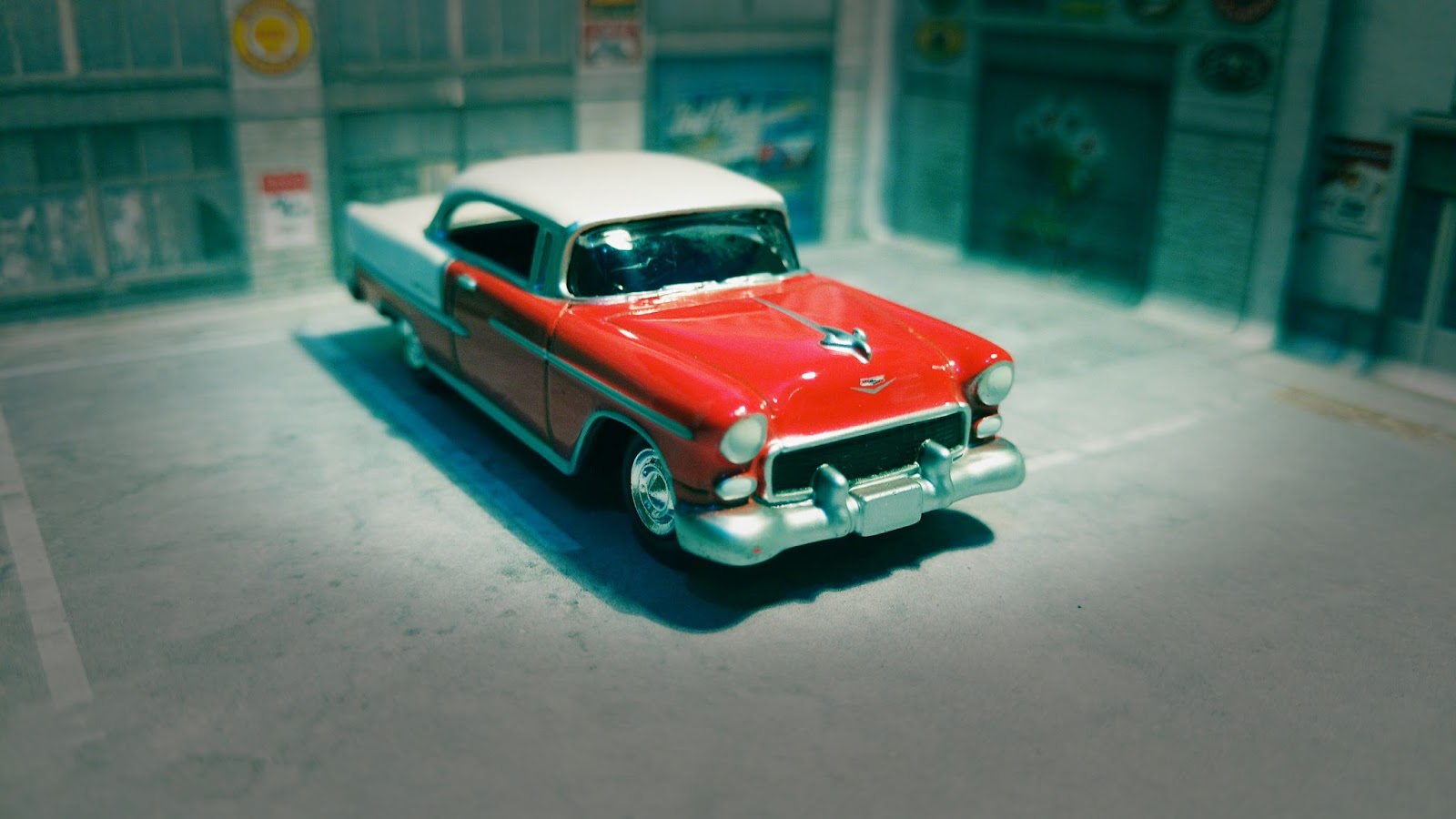
55' Chevrolet Bel Air (Greenlight Motor World series)


The Chevrolet Bel Air was a full-size automobile that was produced by Chevrolet for the 1950–1981 model years. Initially only the two door hardtops in the Chevrolet model range were designated with the Bel Air name from 1950 to 1952, as distinct from the Styleline and Fleetline models for the remainder of the range. With the 1953 model year the Bel Air name was changed from a designation for a unique body shape to a premium level of trim applied across a number of body styles. The Bel Air continued with various other trim level designations until US production ceased in 1975, production continued in Canada for its home market only through the 1981 model year.

From 1955 to 1957, production of the two-door Nomad station wagon was assigned to the Bel Air series, although its body and trim were unique to that model. Prior to becoming a regular production model, the Nomad first appeared as a Corvette-based concept vehicle in 1954. Chevrolet has since unveiled two concept cars bearing the Nomad name, most recently in 1999. The 1955–1957 Chevrolets are commonly referred to as TriFives.

The 1955-1957s were made in right-hand drive and shipped from Oshawa, Canada, for local assembly in Australia (CKD), New Zealand (SKD), and South Africa. All three model years had a reversed version of the '55 LHD dashboard and did not get the LHD models' 1957 redesign.